
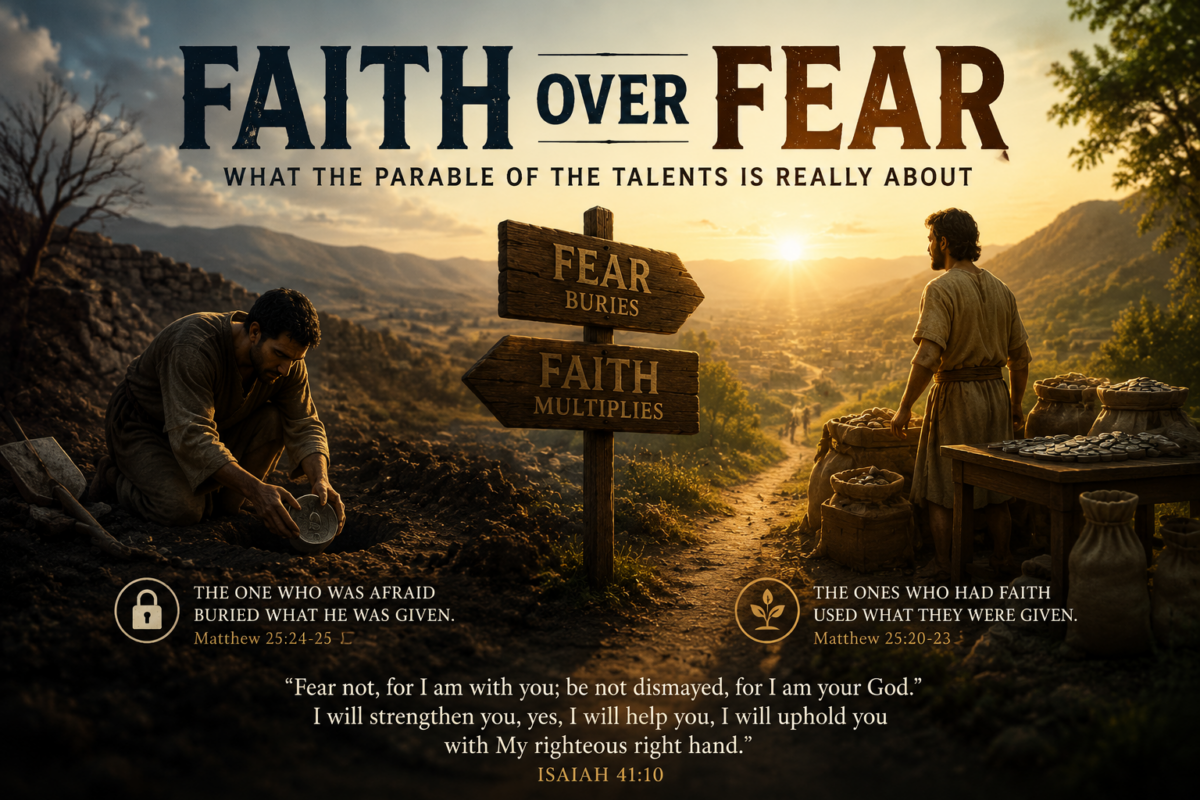
“Fear not, for I am with you; be not dismayed, for I am your God. I will strengthen you, yes, I will help you, I will uphold you with My righteous right hand.”
— Isaiah 41:10
A few days ago, after my regular Aikido practice, I was driving home with one of my Aikido friends. As is often the case after training, our conversation drifted from techniques and martial arts to family, work, life, and the challenges we all face.
At one point, we began talking about people with incredible potential who never seem to fulfil it. We all know someone who is gifted, intelligent, creative, or capable, yet never takes the leap of faith to use those gifts. Instead, they remain in their comfort zone, afraid of failure, afraid of criticism, or simply afraid of the unknown.
It made me think of one of Jesus’ most well-known teachings—the Parable of the Talents found in Matthew 25:14–30.
As we spoke, I also mentioned something that has always encouraged me. Throughout the Bible, God repeatedly tells His people, in one way or another, “Do not fear.” It has often been said that this command appears 365 times in Scripture—one reminder for every day of the year. Whether that exact number is literal or symbolic is beside the point. The message is unmistakable: God continually calls His people to trust Him instead of allowing fear to rule their lives.
The more I reflected on our conversation, the more I realised that this parable is not simply about using our talents. At its heart, it is about overcoming fear through faith.
Understanding the Parable
In the parable, a master prepares to leave on a journey and entrusts his wealth to three servants.
One receives five talents.
Another receives two.
The last receives one.
Each servant receives according to his ability.
The first two servants immediately put their master’s money to work. When the master returns, they have doubled what was entrusted to them.
Both receive exactly the same commendation:
“Well done, good and faithful servant… Enter into the joy of your master.”
(Matthew 25:21, 23)
The third servant, however, does something very different.
He digs a hole in the ground and buries the talent.
When the master returns, he simply hands back what he was originally given.
His explanation is striking:
“Master, I knew you to be a hard man, reaping where you did not sow, and gathering where you scattered no seed, so I was afraid, and I went and hid your talent in the ground. Here, you have what is yours.“
(Matthew 25:24–25)
Notice what Jesus says was the servant’s motivation.
Not laziness.
Not lack of ability.
Not ignorance.
Fear
What Was a Talent?
To understand the weight of this parable, we need to understand what a “talent” meant in Jesus’ day.
A talent was not a natural ability as we often use the word today. It was an enormous unit of money—approximately twenty years’ wages for an average labourer.
This was an extraordinary amount of wealth to entrust to anyone.
We also need to understand another important historical detail. During the first century, burying valuables in the ground was a common way of protecting them. Archaeological discoveries have uncovered numerous buried hoards of coins and precious metals, confirming this practice.
To the people listening to Jesus, burying money was not considered foolish—it was considered safe.
Jesus deliberately used an everyday practice that His audience understood.
The servant wasn’t trying to steal the money.
He was trying to protect it.
He chose safety over trust.
The Real Lesson
Many people read this parable and conclude that it teaches us not to be risk-averse.
While that is certainly part of the lesson, I believe Jesus is pointing us to something even deeper.
The third servant’s greatest problem was not that he buried the talent.
His greatest problem was the reason he buried it.
He says,
“I was afraid.”
Fear kept him from acting.
But where did that fear come from?
It came from his view of the master.
He believed his master was harsh, demanding, and impossible to please.
His misunderstanding of the master’s character produced fear.
That fear produced inaction.
His inaction produced an empty life.
His empty life ended in judgment.
The first two servants saw the same master, received different amounts, and yet acted with confidence because they trusted him.
The difference was never the amount they received.
The difference was their trust.
What Does This Mean for Us?
I believe this speaks directly into our own lives.
God entrusts each of us with different gifts, responsibilities, and opportunities with His infinite wisdom and our capacity to steward them. He knows us better than we know ourselves and never calls us without also providing the grace we need to be faithful.
The danger is not that we have too little.
The danger is that fear convinces us to bury what God has entrusted to us.
Fear whispers that we are not good enough.
Fear tells us we might fail.
Fear tells us that someone else is more qualified.
Fear tells us to wait until the “perfect” moment.
But faith reminds us that our confidence has never been in ourselves.
It has always been in God.
Our faith should never rest in the gift, but in the Giver.
We are not called to trust our own ability—we are called to trust the One who entrusted us with the ability.
The Creator—not the creation.
Fear Not
Throughout Scripture, whenever God called ordinary people to extraordinary tasks, His words were remarkably consistent.
To Moses, to Joshua, to Gideon, to Jeremiah, to the disciples.
Again and again, God said,
“Do not fear.”
Not because there would be no challenges.
Not because failure was impossible.
But because
He would be with them.
Perhaps today God has placed something on your heart that you have buried because of fear.
A calling, a ministry, a business, a dream, a conversation you know you need to have, an act of obedience that you have delayed.
Maybe the greatest obstacle is not your lack of ability.
Maybe it is your fear.
If so, remember where your confidence truly belongs.
Not in your talent.
Not in your experience.
Not in your resources.
But in the One who entrusted them to you.
Step forward in faith.
Trust the Giver more than the gift.
Don’t allow fear to bury what Heaven has entrusted to you.
For the God who sees us, knows us, and loves us is also the God who walks beside us.
“Fear not, for I am with you; be not dismayed, for I am your God. I will strengthen you, yes, I will help you, I will uphold you with My righteous right hand.”
— Isaiah 41:10