
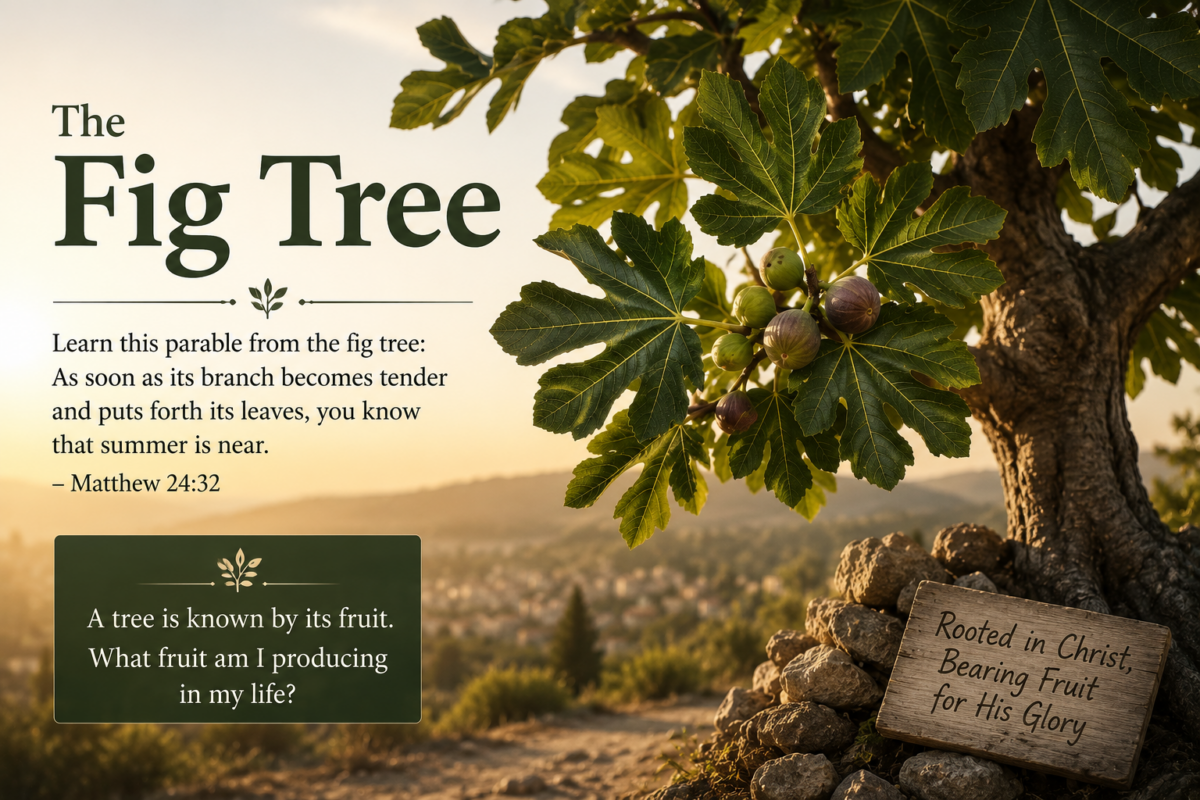
One of the passages that puzzled me for a long time was the account in the Gospels of Gospel of Mark and Gospel of Matthew where Jesus curses a fig tree, and the tree withers away from its roots.
At first, this was very confusing to me for two reasons:
So why did Jesus curse the fig tree simply because He was hungry and could not find fruit on it?
And why did the tree wither from the inside out — from its roots?
The more I studied this passage, especially in the context of what was happening around Jesus at that time, the more it began to make sense.
The Gospel of Mark presents these events in a very intentional structure.
First comes the fig tree.
“And on the morrow, when they were come from Bethany, he was hungry:
And seeing a fig tree afar off having leaves, he came, if haply he might find any thing thereon: and when he came to it, he found nothing but leaves; for the time of figs was not yet.
And Jesus answered and said unto it,
‘No man eat fruit of thee hereafter for ever.’
And his disciples heard it.”
Jesus approaches the tree expecting fruit because the tree is covered in leaves. Yet when He examines it closely, He finds nothing but outward appearance.
No fruit.
Then immediately after this comes another event.
“And they come to Jerusalem: and Jesus went into the temple, and began to cast out them that sold and bought in the temple…”
And He taught, saying unto them,
"Is it not written, My house shall be called of all nations the house of prayer? but ye have made it a den of thieves.”
This suddenly begins to mirror the fig tree.
Outwardly, the temple appeared holy:
From the outside, it looked spiritually alive and fruitful.
But inwardly, Jesus found corruption:
Just like the fig tree, the temple had leaves — but no fruit.
The next morning the disciples pass by again.
“And in the morning, as they passed by, they saw the fig tree dried up from the roots.
And Peter calling to remembrance saith unto him,
‘Master, behold, the fig tree which thou cursedst is withered away.’"
This is what ties the entire passage together.
The fig tree was not merely about hunger.
It was a living parable.
When studying fig trees more closely, something fascinating appears.
Unlike many trees, fig trees begin producing small fruit buds before or together with the leaves. A healthy fig tree showing full leaves would normally also show signs of fruit.
The leaves were advertising fruitfulness.
But inwardly, the tree was barren.
This is the heart of the message.
Jesus was not judging the outward leaves.
He was searching for fruit.
The temple looked holy outwardly, but inwardly it lacked:
Even many who came there were focused more on buying and selling than on drawing near to God.
The leaves were there.
But the fruit was missing.
One of the deepest parts of this passage is that the fig tree withered from its roots.
This points to something profound:
corruption always begins inwardly before it becomes visible outwardly.
A tree dies from the roots first.
The same was happening spiritually within the temple system.
And within around forty years, the Jerusalem temple itself would be destroyed by the Romans in 70 AD.
In essence, the deeper question becomes:
Who are we rooted in?
Who — or what — is truly the source of our life?
Because if the root is not grounded in God, the fruit produced from that life will eventually become corrupted.
A tree can appear healthy outwardly for a season, but if the roots are diseased, the fruit will eventually reveal it.
Jesus was constantly pointing people beyond outward appearances and toward the condition of the heart — the hidden root from which all fruit grows.
This passage is not merely about an ancient fig tree or the temple.
It is also about us.
There are many people who appear righteous outwardly:
But inwardly their hearts may still be filled with:
Jesus consistently taught that God looks beyond appearances and examines the heart.
This is why Jesus says:
“A tree is known by its fruit.”
God is not searching merely for leaves of religion.
He is searching for the fruit that comes from a transformed heart.
Jesus is not asking us merely to appear holy.
He is calling us to become holy inwardly:
When the roots are healthy, fruit naturally appears.
But when the roots are corrupted, eventually the entire tree withers.
The warning of the fig tree is ultimately this:
Outward appearance cannot replace inward transformation.
And that is what Jesus was truly seeking.